NASA's Psyche Mission Snaps Stunning Crescent Mars Image Ahead of Critical Gravity Assist
Breaking: Psyche Spacecraft Captures Mars on Final Approach for Speed Boost
NASA's Psyche mission has captured a dramatic colorized image of Mars as a thin crescent, taken from about 3 million miles (4.8 million kilometers) away on May 3, 2026. The spacecraft is barreling toward the Red Planet for a crucial gravity assist on May 15, designed to slingshot it toward its ultimate destination, asteroid Psyche, arriving in 2029.
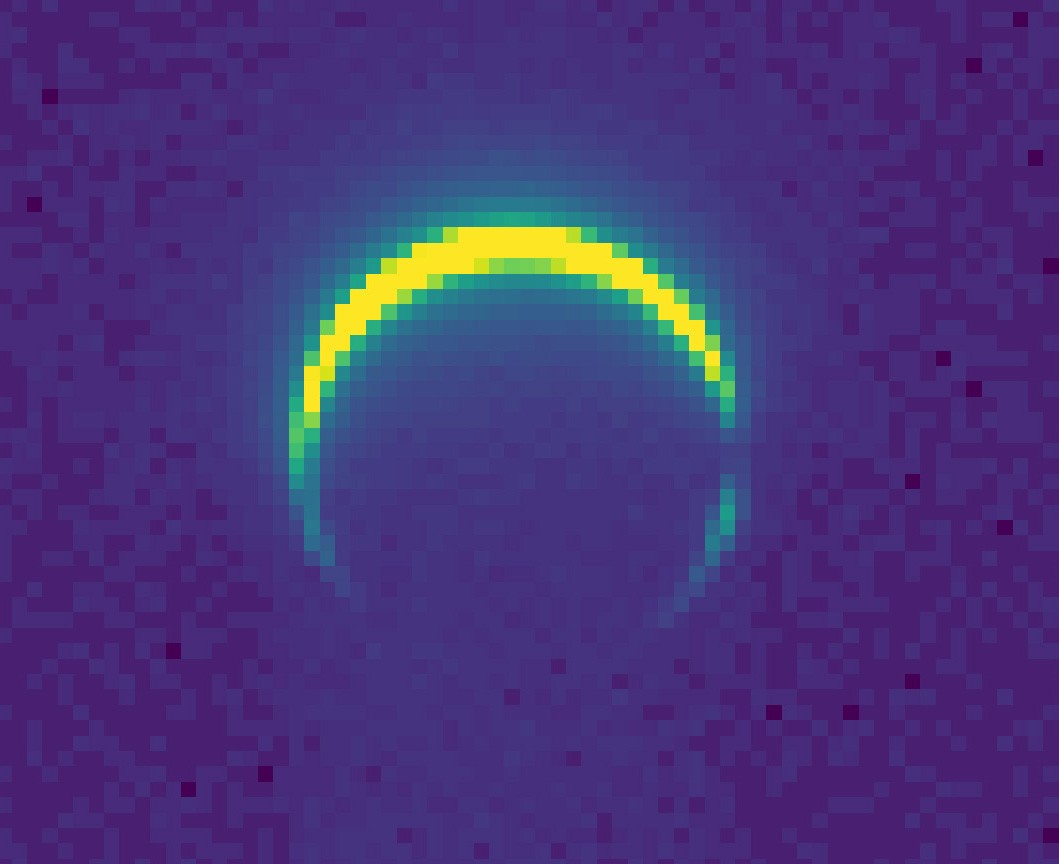
“This early image is both a calibration milestone and a breathtaking preview of the science we’ll do at Psyche,” said Dr. Lindy Elkins-Tanton, principal investigator for the Psyche mission at Arizona State University. “Seeing Mars as a crescent reminds us how different viewing geometries can reveal new aspects of a planet’s atmosphere.”
What the Image Reveals
Because the spacecraft is approaching Mars from a high-phase angle — with the Sun positioned out of frame and “above” both Mars and Psyche — the planet appears only as a thin sliver of light, akin to Earth’s crescent moon. The observation was taken using the multispectral imager’s panchromatic filter with an exposure time of just 2 milliseconds, yet parts of the image are oversaturated due to the intense brightness of sunlight reflecting off Mars.
The dusty Martian atmosphere scatters sunlight, causing the crescent to extend farther around the planet than it would on an airless body like the Moon. Surprisingly, on the right side of the extended crescent, a distinct gap is visible — a feature mission specialists attribute to the planet’s icy north polar cap, currently in winter.
“We hypothesize that seasonal clouds and hazes are forming over the north polar cap, blocking the atmospheric dust’s ability to scatter sunlight as it does elsewhere,” said Dr. Jennifer T. B. Scott, a member of the Psyche imager team at NASA’s Jet Propulsion Laboratory. “This gap gives us a unique window into Martian weather patterns.”
Background: Psyche’s Journey to a Metal World
Launched in October 2023, NASA’s Psyche mission is tasked with exploring the metal-rich asteroid 16 Psyche, thought to be the exposed core of an early planet. The spacecraft has been traveling through the inner solar system, using ion propulsion and gravity assists to gain speed. The Mars flyby on May 15 will adjust its trajectory and provide an extra boost, cutting months off the journey to the asteroid belt.
The current images are primarily intended to calibrate the cameras and characterize their performance in flight—a practice run for the approach to asteroid Psyche in 2029. The imager team will continue acquiring and processing similar observations daily in the lead-up to the close approach.
What This Means
The successful capture of Mars during this gravity assist approach validates the imager’s capabilities and confirms that the spacecraft is on the correct trajectory. The unexpected detail of a polar gap highlights how even routine calibration images can yield scientific insights, particularly into Martian atmospheric dynamics.
For the Psyche mission, each step brings it closer to answering fundamental questions about planetary formation. “This flyby is a rehearsal — a chance to perfect our techniques before we reach the asteroid,” said Dr. Elkins-Tanton. “Every image we take now makes our science at Psyche stronger.”
The next major milestone is the May 15 gravity assist, after which the spacecraft will continue its journey, with arrival at asteroid Psyche targeted for August 2029.