Rethinking the Bicycle’s Drive System: A Crankless Innovation
Introduction: The Enduring Design of the Bicycle
Since the late 19th century, the bicycle has remained remarkably consistent in its core architecture. A diamond frame, two equal-sized wheels, and a pedal crank connected to a chain drive have become the gold standard. While materials have evolved from steel to carbon fiber and components have grown lighter and more efficient, the fundamental principle of converting circular pedal motion into forward momentum has not changed. Any 19th-century bicycle mechanic walking into a modern shop would instantly recognize the machine—until now. A builder known only as Not Programming has challenged this century-old formula with a crankless bicycle that replaces the familiar rotating crank with a linear motion system.
The Crankless Bicycle: A New Way to Pedal
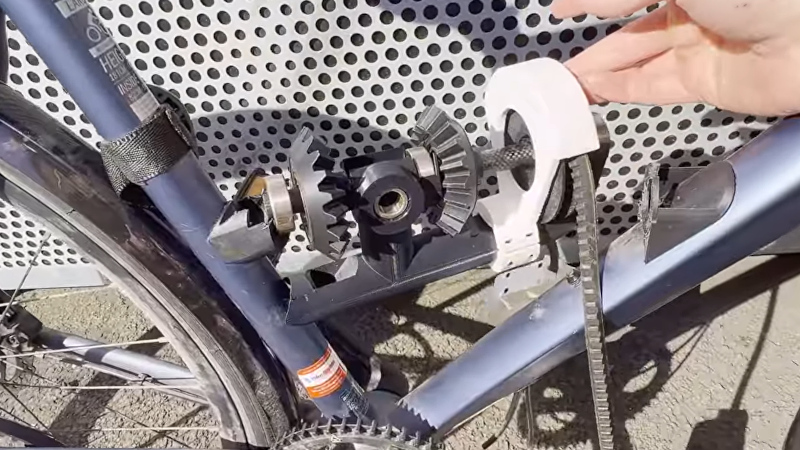
The core idea is deceptively simple: instead of pushing pedals in a circle, the rider applies force in a straight, back-and-forth motion. This linear input is then converted into rotational energy to drive the rear wheel. Not Programming’s design draws inspiration from a previous concept that used a sinusoidal track inside a rotating cylinder to achieve the conversion. However, this new approach employs what the builder calls a “mechanical rectifier”—an arrangement of gears and freewheels that transforms reciprocating motion into continuous rotation.
The Mechanical Rectifier Explained
The mechanical rectifier is the heart of the system. It consists of a set of gears and one-way clutches (freewheels) that ensure that regardless of the direction of the pedal stroke, the output shaft rotates in a single direction. As the rider pushes the pedal forward, the gear train engages; when the pedal is pulled back, another set of freewheels takes over, maintaining the drive. This clever mechanism eliminates the dead spots inherent in circular cranks—the top and bottom of the stroke where little torque is produced—promising a more constant and efficient power delivery.
Pedal Design: Stirrups on a V-Belt
Instead of conventional pedals attached to crank arms, Not Programming mounted stirrup-shaped pedals at each end of a V-belt. The belt runs over pulleys, allowing the pedals to slide back and forth linearly. The rider’s feet are secured in the stirrups, and the motion is akin to a stepping or gliding movement rather than the familiar circular spin. This arrangement not only facilitates the linear input but also allows for a more natural leg extension, potentially reducing strain on the knees.
3D Printing at the Limit
The entire drivetrain—gears, freewheel housings, belt pulleys, and structural mounts—was fabricated using 3D printing. Not Programming pushed the limits of desktop printing, using materials like PETG and reinforced PLA. The iterative process was grueling: prototype after prototype sheared under the high torque loads generated during pedaling. Each failure provided data to reinforce critical stress points, add fillets, and improve layer adhesion. After multiple iterations, a functional version finally held together under real-world pedaling forces. This persistence highlights both the promise and the current limitations of 3D-printed mechanical components.
Historical Context and Comparisons
This is not the first attempt to redesign the bicycle’s drivetrain. Earlier efforts have included shaft drives, belt drives, and even the stringbike, which uses a rope and pulley system. Notably, this is also not the first 3D-printed bicycle geartrain—a point the builder himself acknowledges. However, the combination of a linear-to-rotary mechanical rectifier with 3D printing is novel and demonstrates how rapid prototyping can accelerate innovation in even the most mature industries.
Why This Matters
While the crankless bicycle is unlikely to replace the classic crank anytime soon, it serves as a proof of concept. It challenges the assumption that the circular crank is optimal. By eliminating the varying torque output of a crank, a linear system could theoretically offer smoother power delivery, which might benefit applications like indoor cycling, rehabilitation, or even human-powered vehicles where constant force is advantageous. Moreover, the open sharing of designs and failures (a hallmark of the maker movement) encourages others to iterate and improve.
Conclusion: Pedaling Forward
Not Programming’s crankless bicycle is a bold experiment that respects the past while questioning it. By replacing a 130-year-old mechanism with a 3D-printed linear drive, it shows that even the most entrenched designs can be reimagined. Whether this leads to a commercial product or simply inspires further tinkering, one thing is certain: the way we pedal is no longer set in stone.