5 Key Upgrades in Meta’s End-to-End Encrypted Backup System
Intro: End-to-end encryption (E2EE) ensures that only you and the intended recipients can read your messages — not even Meta can access them. But what about backups? If your chat history is saved to the cloud, it could be vulnerable. Meta has been building a robust system to protect these backups, using hardware security modules (HSMs) and innovative cryptographic techniques. Here are five crucial upgrades that are strengthening E2E encrypted backups for WhatsApp and Messenger, making your data safer than ever.
1. The Foundation: HSM-Based Backup Key Vault
Meta’s HSM-based Backup Key Vault is the bedrock of encrypted backups for both WhatsApp and Messenger. This system allows users to safeguard their message history with a recovery code, stored securely in tamper-resistant HSMs. The key vault is designed so that no single entity — not Meta, not cloud storage providers, nor any third party — can access the recovery data. Instead, the vault is spread across multiple datacenters worldwide, ensuring high availability and resilience. This architecture uses majority-consensus replication to maintain data integrity and uptime. By keeping the recovery code locked inside HSMs, Meta ensures that even if the cloud infrastructure were compromised, your backup remains private. The vault represents a fundamental shift toward user-controlled data protection, giving people genuine ownership of their message history.
2. Unbreakable Recovery Codes via Tamper-Resistant HSMs
At the heart of the backup system is the recovery code — a secret that can restore your entire message history. Meta stores this code inside dedicated hardware security modules (HSMs) that are physically and cryptographically tamper-resistant. These HSMs are certified to industry standards and are operated in secure facilities. The recovery code never leaves the HSM in plaintext; it is only used to decrypt backup data when the correct user credentials are provided. Moreover, Meta cannot extract the code or bypass the encryption. This design prevents unauthorized access, whether from internal engineers, government requests, or hackers. Recently, Meta made it easier to use passkeys for backup encryption, adding a biometric or device-based layer. However, the recovery code remains the ultimate fallback, and its protection inside HSMs is critical to maintaining end-to-end confidentiality.
3. Global Resilience with Geographically Distributed Fleets
To ensure the Backup Key Vault is always available and resistant to failures, Meta deploys it as a geographically distributed fleet across multiple datacenters. Data is replicated using a majority-consensus protocol, meaning that even if one datacenter goes offline, the system continues to operate seamlessly. This distribution also thwarts targeted attacks: compromising a single location wouldn’t reveal the recovery code or disrupt service. The fleet is managed as a cluster of HSMs that collectively handle backup encryption and decryption requests. Each HSM in the fleet operates independently but coordinates to maintain consistency. For users, this means your backup is always accessible when you need it, while remaining secure from regional outages or physical breaches. This global footprint is a key part of Meta’s commitment to reliability without sacrificing privacy.
4. Seamless Fleet Key Distribution Over the Air for Messenger
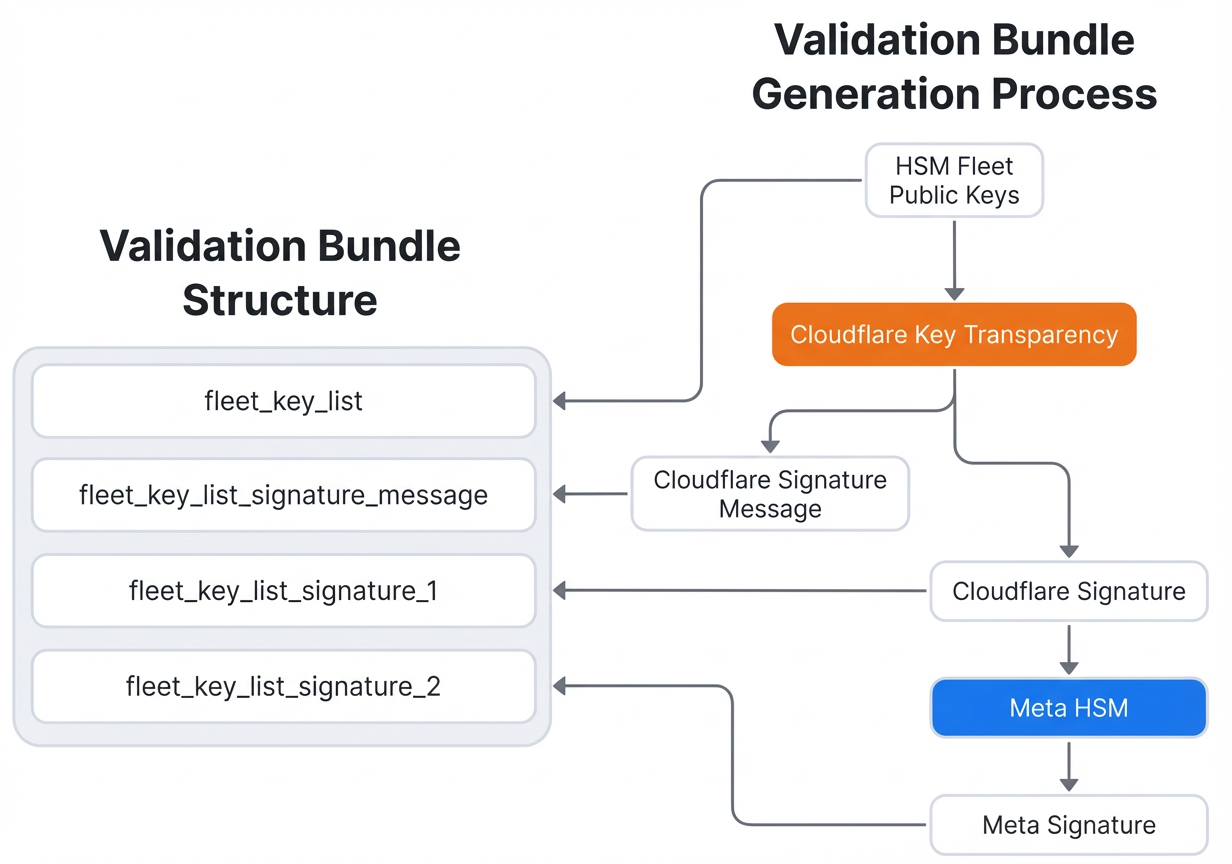
One challenge with HSM fleets is ensuring clients can verify they are communicating with an authentic fleet. In WhatsApp, the fleet’s public keys are hardcoded into the app, so users implicitly trust them. But for Messenger, where new fleets may be deployed without requiring an app update, Meta built an over-the-air fleet key distribution mechanism. When a device connects to an HSM, the HSM responds with a validation bundle containing its public keys. This bundle is independently signed by Cloudflare and then counter-signed by Meta, providing two layers of cryptographic proof. Cloudflare also maintains an audit log of every validation bundle issued, adding transparency. Clients validate the signatures before establishing a secure session. This approach allows Meta to rotate or add HSM fleets dynamically, while ensuring users can always verify authenticity — no app update needed. It’s a flexible, secure solution for scaling encrypted backups across Messenger.
5. Transparency in Fleet Deployment with Public Evidence
Trust requires proof. Meta has committed to publishing evidence of each new HSM fleet deployment on its engineering blog, showing that the system operates exactly as designed and that Meta cannot access user backups. New fleet deployments are rare — typically only every few years — but when they happen, Meta will provide detailed documentation that any security researcher can audit. The evidence includes cryptographic attestations, deployment logs, and verification steps outlined in the official whitepaper. Users and independent auditors can follow the process to confirm that the new fleet is genuine and secure. This transparency sets a new standard for encrypted backup systems, proving Meta’s claims are verifiable. By opening up the deployment process to public scrutiny, Meta reinforces its leadership in user privacy and demonstrates that end-to-end encryption can coexist with operational resilience.
Conclusion: From the tamper-resistant HSM vault to over-the-air key distribution and public deployment transparency, Meta is raising the bar for encrypted backups. These five upgrades ensure that your WhatsApp and Messenger chat histories remain private, even when stored in the cloud. For the complete technical details, read the full whitepaper: Security of End-To-End Encrypted Backups. The future of private messaging is here — and it’s built on a foundation of cryptographic rigor and openness.